Why Professional Exterior Painting in Massachusetts Requires Special Prep
Massachusetts homeowners deal with one of the most demanding climates for exterior paint in the country. Sub-zero winters, freeze-thaw cycles that can repeat 30–40 times per season, humid summers, and intense UV from July through September- all of it works continuously against exterior coatings. A paint job that would last 12 years in Southern California might fail in five here if it isn’t applied correctly.
Here’s what proper exterior prep looks like in our climate, and why cutting corners shows up quickly.
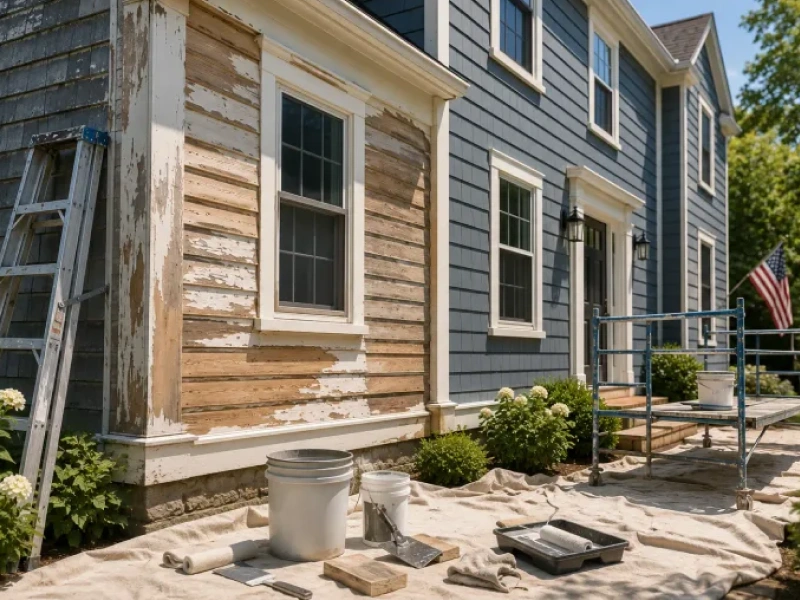
Power Washing Is the Starting Point, Not the Whole Job
Every professional exterior job starts with a thorough power wash to remove dirt, mildew, and chalked paint residue. But power washing alone doesn’t make a surface ready to paint. It reveals what needs to be done next: loose paint that needs scraping, bare wood that needs priming, failed caulk that needs replacing, and rot that needs repairing before any coating goes on.
Scraping and Feathering Loose Paint
Any paint that has lost adhesion to the substrate has to come off completely. Painting over peeling paint just extends the failure. After scraping, the edges of remaining paint get feathered (sanded smooth) so the new coat bridges the transition rather than telegraphing the edge.
Wood Rot Inspection and Repair
Freeze-thaw cycles force moisture into even small paint failures, and once water reaches unprotected wood, rot follows. On every exterior job, we inspect all trim, fascia, window sills, and siding for soft spots. Minor rot can often be stabilized with epoxy consolidants and filler; more significant damage requires wood replacement before painting.
Priming Bare Wood, Always
Any area where old paint has been removed down to bare wood must be primed before finish coats. This is non-negotiable in New England. Bare wood is porous and will absorb moisture from the first rain if left unprimed, swelling and lifting the new paint within a season. We use a quality oil-based or shellac-based primer on problematic areas and a high-adhesion latex primer everywhere else.
Caulking All Penetrations
Water doesn’t just penetrate through paint failures; it enters through gaps at window and door frames, corner boards, and where dissimilar materials meet. Before any paint goes on, all joints get inspected and re-caulked with a paintable exterior-grade caulk. This is the most overlooked step in residential exterior painting, and skipping it is the most common reason for premature paint failure.
Timing Matters in New England
Exterior latex paint should not be applied below 50°F, and ideally above 60°F with temperatures expected to stay there for 24 hours after application. In Massachusetts, this limits the exterior painting season roughly from late April through October. Rushing into cold temperatures to meet a deadline is a shortcut that fails within the first winter.
Our Commitment
We’ve been painting exteriors across Massachusetts’s South Shore for years. We’ve seen the consequences of shortcuts: calls from homeowners whose fresh paint is already peeling a year after a “bargain” contractor finished the job. Our process prioritizes prep because that’s where the longevity is.
Ready to invest in a paint job that actually holds up? Contact WG Construction for a free estimate and honest assessment of your home’s exterior.